
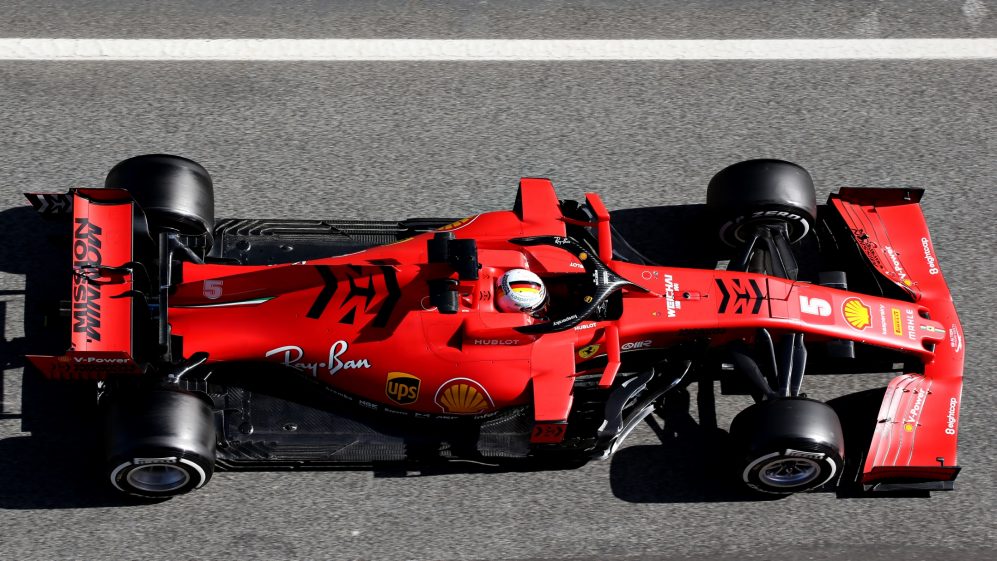
The secrets of the scarlet bullet that is eager to start racing in 2020…
by Spyros Pettas
The initial aerodynamics of the Ferrari SF1000 are quite simple except from the rear area of the floor where Maranello is ahead of the competition for some time now. The innovative flap there in front of the rear wheel has vanished because it generated a lot of drag. The nose remains wide and the front wing still follows the “outwash” philosophy. The bargeboards are of the boomerang type, an early design of Mercedes F1 that dates back in 2017 and was soon followed by Red Bull. Mercedes seems to be in front in the barge board area…
The elements of the front suspencion are positioned low for an aerodynamic gain (this way they do not disrupt the upper flow that gets to the sidepod inlets - an idea of Simone Resta and the mentor Rory Byrne from 2017) and a low center of gravity.
But is Ferrari's wide nose - “outwash” philosophy a successful one, a thing many have doubted? We believe that it is. It dominated in Spa, Bahrain and Singapore, it won in Monza and it could have won in Baku, Austria, Hockenheim, Sochi, Mexico City and finally Suzuka in 2019…
The integration problems of the rear wing, that begun in the end of 2018 have been solved in Baku in the beginning of 2019. We have to add that Enrico Cardile (an aerodynamicist that comes from the GT department and is a University of Pisa graduate) and David Sanchez (who was also partially involved in the GT aerodynamics department in the beginning of his Ferrari career) do a great job, and are now aided full time by Simone Resta.
Ferrari's main goal in 2020 is to reduce the excessive drag and mainly to obtain a better tyre management a goal that in Barcelona in pre season testing was partially achieved. The tyre management of 2019 was enigmatic and problematic for the obvious reasons. Pirelli in 2019 brought for the races “a la carte” tyres for Mercedes and those remain identical in 2020...
Ferrari SF1000 is also equipped with an Ackerman type variable Power Assisted System (PAS). When the pilot steers the wheel, the external front wheel turns more than the internal one and the greater the steering angle gets the greater the difference becomes. It helps obtain better tyre management and it helps also in the “fight” against understeer. Some say that PAS is more important than DAS (Dual Axis Steering) and Mercedes has both…
The Power Unit
It erogates more than 1150 bhp, and in 2020 is going to be ahead of the field with quite a difference. The initial version of the thermal engine erogates 840 bhp. Add to that the 164 BHP of KERS (Kinetic Energy Recovery System) and more than 200 BHP of the third generation of the bipolar ERS (Energy recovery System) and the math is there…
Ferrari is ahead in the areas of engine parts composition, fluid dynamics, ERS performance and radiator surface technology. Enrico Gualtteri, Corado Lotti, Wolf Zimmerman and their staff do a fantastic job.
Let's just hope that racing begins soon so we can see this fantastic singleseater back in action...